
Brain Puzzle 2: Logic Twist
JoyGame StudioPuzzle
4.7556.00 Reviews
- Version
- 1.3.5
- Installs
- 10.00M
- Age Rating
- Teen
Screenshots






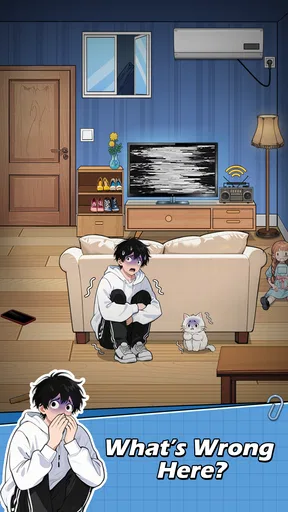

Our Review of Brain Puzzle 2: Logic Twist
 Analysis by Appyee
I went into Brain Puzzle 2: Logic Twist expecting a quick collection of trick questions, but its appeal is less about rushing through puzzles and more about learning to distrust your first answer. This free puzzle game from JoyGame Studio repeatedly presents a small problem, nudges me toward an obvious interpretation, and then rewards the moment I notice the detail I initially ignored. That simple pattern gives each challenge a satisfying little arc: I try an action, see the result, adjust my thinking, and decide whether I want another attempt.
The game sits comfortably in the casual brain-teaser space, yet it is not the kind of puzzle experience I would choose when I want a long, quiet logic exercise. Its challenges are designed around short bursts of attention. I can play while waiting for an appointment, take a break between tasks, or hand the phone to someone nearby and compare our first guesses. The Teen content rating is worth keeping in mind for families, but the main attraction is its accessible format rather than a complicated story or a deep progression system.
How the puzzle loop keeps pulling me back
I find the loop most rewarding when I treat each attempt as a small experiment rather than a guess I need to get right immediately. That shift helps me notice whether the puzzle is testing the wording, the scene, or my assumptions about what can be touched. It also makes it easier to decide when to pause instead of tapping at random, which leads naturally to the practical habits that make these short challenges more satisfying.
The first action is usually a test of assumptions
What I like most about the opening move in each challenge is that it rarely feels like a conventional mathematics problem. Instead, I look at the scene, read the prompt, and decide what the game appears to be asking. My first action might be tapping an object, choosing an answer, or interacting with something that seems decorative. The important part is not simply knowing a rule; it is recognizing that the visible situation may be hiding the actual solution.
That makes the game approachable for people who do not normally call themselves puzzle players. I do not need to memorize a complicated control scheme, and the early friction comes from interpretation rather than dexterity. At the same time, the simplicity can be deceptive. A person who taps quickly without examining the wording may spend more time retrying than someone who pauses for a few seconds and checks every part of the screen.
My most useful habit was to treat the first attempt as information gathering. Rather than viewing an incorrect tap as wasted time, I used it to learn what the game considered interactive and what it ignored. This is a small but important shift: the game becomes a conversation between my decision and its response. Players who enjoy spotting visual clues will probably settle into that rhythm quickly, while anyone looking for precise, traditional logic-grid puzzles may find the presentation too playful.
Feedback arrives quickly, so mistakes stay manageable
The feedback rhythm is the strongest reason a failed attempt does not become frustrating immediately. I can see whether my interpretation worked, then reconsider the scene while the original idea is still fresh. That quick response keeps the mental distance between action and correction short. I am not left wondering whether I misunderstood the instructions or simply missed a delayed result.
This also makes the game suitable for sharing a screen with another person. One player can suggest an answer, another can challenge the assumption, and the result settles the argument almost instantly. It works especially well as a short social distraction because the puzzles are easy to explain aloud without turning into a long rules lesson. I would not describe it as a multiplayer game, but the compact challenges naturally invite conversation.
There is a trade-off here. Fast feedback makes the puzzles feel lively, but it can also reduce the sense of discovery for players who prefer to sit with one problem for a long time. If I want a single demanding challenge that occupies an entire evening, a conventional logic-puzzle app is likely a better match. This game is built around frequent small revelations, not extended deduction.
The reward is the change in perspective
The most satisfying reward is not the simple fact that I cleared a level. It is the moment when the scene suddenly makes sense from a different angle. A prompt that looked obvious becomes a test of language, placement, or attention. I enjoy that brief feeling of being fooled and then understanding why the trick worked.
That design also gives the game a useful everyday benefit: it encourages me to slow down before acting. When I am stuck, I now check whether I am following the wording too literally, whether I have ignored an apparently minor object, and whether I am assuming that the largest item on screen is the important one. These are practical habits for this particular style of puzzle, and they are more useful than randomly tapping everything.
Still, the reward depends heavily on whether a player enjoys “gotcha” logic. Some solutions feel clever because they expose a hidden assumption; others can feel arbitrary if the intended interaction was not visually obvious. I found that distinction important. When the clue and solution connect, the payoff is excellent. When the answer depends on an interaction I would not reasonably consider, satisfaction drops and the retry feels more like trial and error.
Resetting the session is part of the appeal
After solving a few challenges, I often put the game down without feeling that I had abandoned a large commitment. That is one of its practical strengths. A session can begin with a single puzzle and end naturally after a handful of attempts. There is no need for me to reserve a long block of time or remember a complicated objective before returning.
The reset is psychological as much as practical. Each new challenge gives me a clean starting point, so a mistake from the previous puzzle does not weigh on the next one. If I become too confident and start tapping automatically, closing the game and returning later helps restore the cautious mindset that the puzzles reward. This makes it a better fit for short breaks than for players who want a continuous adventure with a strong narrative reason to keep going.
I also appreciate that the low commitment makes it easy to use as a shared phone activity. A friend can try one puzzle, fail, laugh at the hidden trick, and pass the device back. The same structure is less appealing if I want a persistent world, character development, or a clear long-term project. Brain Puzzle 2 is at its best when I want a compact mental reset rather than a second job inside my phone.
Who will enjoy it, and who should skip it?
I would recommend this game to casual players who like visual riddles, misleading wording, and short challenges that reward observation. It is also a good choice for someone who wants a puzzle app that can be opened without preparation. The controls are easy to understand, and the central skill is flexible thinking rather than fast reactions.
I would be more cautious about recommending it to players who dislike trick questions or who expect every solution to follow formal, predictable logic. Someone who prefers Sudoku, nonograms, chess puzzles, or carefully structured deduction may find the solutions here less rigorous. Those alternatives usually offer a clearer relationship between rules and outcome, while this game often asks me to question the framing of the problem itself.
It is also not my first choice for a young child simply because the listed age guidance is Teen. Parents should make their own judgment about whether the style and individual challenges suit the child. For older players, the approachable format can be a good way to introduce someone to puzzle games without starting with dense instructions or a demanding interface.
What the numbers suggest about its place in the category
The game has reached more than ten million installs and holds a 4.6 average from roughly one hundred eighteen thousand ratings. That level of adoption makes sense to me: the concept is easy to understand from the first puzzle, and the short-session structure removes much of the commitment that keeps people away from more elaborate brain-training titles.
It has also accumulated hundreds of written reviews, which indicates that players have had enough experience to form opinions beyond a first launch. I would not treat popularity as proof that every puzzle will suit every taste, but it does show that this particular blend of quick interaction and surprise has found a broad audience.
Version, access, and practical expectations
Brain Puzzle 2 is free, and the current version is 1.3.0. It supports devices running Android 7.0 or later, so owners of older compatible phones may still be able to try it without needing a recent operating system. Those details make it relatively easy to test as a low-commitment download, especially if I am unsure whether this style of puzzle will hold my attention.
The developer, JoyGame Studio, has positioned the experience around immediate play rather than a lengthy setup. I would still approach it with realistic expectations: free casual puzzle games can vary in how much repetition a player notices over time, and the appeal depends on the quality and fairness of individual twists. The right question is not whether it replaces every other puzzle app, but whether I enjoy its particular action-and-reaction pattern.
Small techniques that improve the experience
My first tip is to read the wording twice, but with different intentions. On the first pass, I ask what the sentence appears to request. On the second, I look for an unusually specific word, an odd limitation, or a phrase that might be steering me toward the wrong object. This takes less time than repeated random tapping and makes the successful solution feel more earned.
My second tip is to inspect the whole screen before touching the obvious target. I look at corners, background objects, spacing, and anything that seems too ordinary to matter. In this genre, visual emphasis can be a distraction, so the largest or brightest element is not automatically the correct starting point. That habit is especially helpful when I am playing quickly during a short break.
A third useful approach is to separate observation from execution. I first describe the puzzle to myself in plain language, then decide what action would test that description. If the result is wrong, I change one assumption at a time instead of trying five unrelated taps. This turns failure into a controlled experiment and reduces the feeling that the answer was chosen at random.
Finally, I avoid using hints or outside help too early when I want the game to sharpen my attention. The best part of a challenge is often the instant before the solution becomes visible. If I am genuinely stuck, taking a short break works better for me than staring at the same arrangement until every object looks equally suspicious. Returning with fresh attention can reveal a relationship I had been mentally filtering out.
How it compares with familiar puzzle alternatives
Compared with Sudoku or crossword apps, this game asks for less sustained planning and more willingness to reinterpret the prompt. Compared with physics-based puzzle games, it places less emphasis on timing and experimentation with movement. And compared with brain-training collections that measure repeated performance, it feels more like a sequence of small surprises than a structured exercise routine.
That difference determines whether it belongs on my phone. If I want to build a daily habit around one stable rule set, I would choose a more formal puzzle app. If I want a quick challenge that can change my mood during a dull wait, this one is more effective. Its best quality is not depth in the traditional sense; it is the way it makes a familiar-looking problem briefly uncertain.
The limitation is that the same surprise-based design can become less rewarding when I recognize the pattern too clearly. Once I start assuming that every prompt contains a trick, the experience risks replacing one automatic response with another. I get the most from it when I remain curious rather than trying to predict the developer’s method on every screen.
My verdict on the complete action-to-reset cycle
For me, the loop works because each part has a clear purpose. I take an initial action based on an imperfect reading, receive immediate feedback, earn the satisfaction of a changed perspective, and then reset for a fresh puzzle without carrying much baggage from the previous one. That cycle explains why I can intend to play for a minute and end up attempting several more challenges.
The best reason to try it is the quality of its small surprises, not the promise of deep long-term progression. I would recommend it to anyone who likes accessible brain teasers and can enjoy being corrected by a clever twist. I would skip it in favor of a traditional logic app if I wanted strict rules, long-form deduction, or a measurable training plan.
Overall, Brain Puzzle 2: Logic Twist is a solid free puzzle game for short, repeatable sessions. Its 2025 release and current 1.3.0 version give it a straightforward entry point for compatible Android users, while the broad audience around it suggests that the format is easy to pick up. I would keep it installed for waiting rooms, casual challenges with friends, and those moments when I want my brain nudged awake without committing to a full game session.
Privacy and Permissions
See what permissions an app requests and how it handles your data.
- Wi-Fi connection information
- view Wi-Fi connections
- Other
- view network connections, full network access, control vibration, prevent device from sleeping, Google Play license check
Verdict
Strengths of Brain Puzzle 2: Logic Twist
- Short levels make it easy to play during quick breaks.
- Creative solutions reward flexible thinking beyond standard logic.
- Simple controls are accessible for most players.
- Works well for casual players seeking light mental exercise.
- Progressive challenges help maintain a steady sense of discovery.
Limitations of Brain Puzzle 2: Logic Twist
- Some solutions can feel arbitrary rather than logically deducible.
- Repeated puzzle patterns may reduce the challenge over time.
- Hints may be limited or tied to watching advertisements.
- Frequent ads can interrupt the flow between completed levels.
- Players seeking deep, complex puzzles may find it too easy.
Other Releases by JoyGame Studio
View All
Brain Puzzle: Tricky Quest
Puzzle4.6

Brain Puzzle 3: Crazy Mind
Puzzle4.7

Puzzle Time: Brainy Challenge
Puzzle4.9
Similar Picks in This Category
View All
Block Blast!
HungryStudio4.8

Braindom: Brain Games Test
Lahana Game Studio4.6

AMAZE!
CrazyLabs LTD4.6

Sudoku - Classic Sudoku Puzzle
Oakever Games4.7

Art Puzzle - Puzzle Games
Easybrain4.8

Amaze GO!
Oakever Games4.9
Frequently Asked Questions
What is Brain Puzzle 2: Logic Twist?
Brain Puzzle 2: Logic Twist is a casual puzzle game built around short, visual challenges that require more than simply following obvious instructions. Each level presents a situation, image, or problem with a hidden trick, encouraging you to inspect the screen carefully and experiment with different solutions. It is designed for quick sessions, making it suitable for relaxing gameplay or a brief mental challenge.
How do you play Brain Puzzle 2: Logic Twist?
The game is mainly controlled through taps, swipes, and interactions with objects shown on the screen. The solution is not always achieved by selecting the most noticeable item, so players may need to move objects, combine actions, or question the wording and visual clues in each level. Progress depends on creative thinking, observation, and trial and error rather than fast reflexes.
Is Brain Puzzle 2: Logic Twist suitable for children?
Brain Puzzle 2: Logic Twist can be enjoyable for children because its controls are simple and many challenges encourage observation and problem-solving. However, some puzzles may be confusing without help, and the game can include advertisements or optional purchases depending on the device and version. Parents should review the store listing and in-app settings before allowing younger children to play.
Does Brain Puzzle 2: Logic Twist require an internet connection?
The basic puzzle experience may work without a constant internet connection, which is convenient for playing while traveling or when mobile data is unavailable. Nevertheless, an internet connection can be needed for advertisements, analytics, updates, cloud-related features, or restoring certain purchases. Availability may vary between Android and iOS versions, so checking the current store description is recommended.
Are there hints, advertisements, or in-app purchases in the game?
The game generally provides assistance for players who become stuck, often through hints or other support options. These features may be limited and can be connected to watching advertisements or using an in-game currency. Advertising frequency and purchase options can differ by platform and region. Before downloading, review the store page and purchase settings if you prefer an uninterrupted or child-friendly experience.
Play our best games!


